Wednesday, 3 August 2011

Gonorrhoea

Gonorrhoea
Gonorrhoea is one of the most common sexually transmitted diseases in the world and it is caused by bacteria. It is spread during sexual intercourse.
Infection with gonorrhoea increases the risk of becoming infected with HIV, but early stage gonorrhoea can be treated with a course of antibiotics. 
Symptoms:
  • the place where the bacteria usually first attack is the urethra and the cervix, therefore, some may feel pain when passing urine or have lower abdominal pains or backache
  • Pus can be discharged from the penis, or for women, yellow or green discharge with a strong smell can be discharged from the vagina
  • it can also infect the rectum, the anus, throat and eyes (in case of a rectum infection, there can be irritation or discharge at the anus)
Effects:
  • it can cause the testicles, prostate gland (for men) and fallopian tubes (for women) to be inflamed
  • infected women may become infertile
  • they may also pass gonorrhoea to their newborn infants during delivery, causing eye infections and blindness in their babies

Family Planning

Family Planning
In family planning, married couples plan when they want to have babies and how many children they want. However, sometimes, the couple does not want to have a baby. They must therefore prevent a sperm from joining with an egg via birth control.
There are two measures of birth control: temporary and permanent. 
Temporary birth control:
In temporary birth control, a couple is able to have children when they wish to. This can be done through using temporary birth control methods.
These are some of the methods:
  • Spermicides (kill or immobilize sperms, preventing fertilisation)
  • Diaphragms (shallow dome shaped rubber or plastic cups that block the opening to the uterus and prevent sperms from fertilising the egg)
  • Male condoms (collects the semen before, during and after intercourse, preventing fertilisation)
  • Female condoms (collects semen before, during and after ejaculation, preventing fertilisation)
  • Intra-uterine devices (IUD, prevents sperms from fusing with the egg or preventing implantation of a fertilised egg onto the uterine wall
  • Contraceptive pills (prevent ovulation or thicken cervival mucus, which keeps sperms from fertilising the egg)
Permanent birth control:
In permanent birth control, a couple is not able to have any more children.
These are the methods:
1) Male sterilization or vasectomy
- removes a section of the sperm duct and the open ends are tied, blocking the sperm ducts and keeping sperms out of the seminal fluid
  1. Female sterilization or ligation
  • closes off the fallopian tubes where the egg is fertilised by a sperm. Middle portion of the fallopian tubes is removed and the open ends are tied
When a couple accidentally gets pregnant, they may get an abortion: a deliberate termination of a pregnancy before the foetus is developed enough to survive outside the uterus.

Birth

Birth
There are two types of births: C-section and natural birth.
Natural birth:
When the baby is about to be born, the head of the baby faces down. The membrane (amniotic sac) around the fetus breaks and the liquid comes out. The mother uses her strong muscles in the womb to push the baby out of the vagina. The baby comes out with the umbilical cord attached. The doctor cuts and ties the cord. The placenta (an organ that connects the fetus to the uterine wall to allow nutrient uptake, waste elimination, and gas exchange via the mother’s blood supply) is released.
C-section:
Also known as Cesarean Section, it involves the doctor surgically operating on the mother to take the baby out, usually cutting open the front of the womb. Mothers who have c-sections are more likely to have an infection, excessive bleeding, blood clots, more postpartum pain, a longer hospital stay, and a significantly longer recovery. 

Puberty

Puberty is the stage of human growth and development in which a person becomes physically mature.
The changes are as follows:
For boys:
  • Facial hair starts to grow and hair appears in pubic region and under armpits.
  • The sex organs increase in size.
  • Production of sperms start.
  • Larynx enlarges and voice deepens.
For girls:
  • Hair appears in the pubic region and under armpits.
  • The breasts and uterus enlarge, hips broaden.
  • Menstruation and ovulation start.
The girls will also start going through what is called a menstrual cycle.
The changes of the Graafian follicle: 
The Graafian follicle is the basic unit of the female reproductive biology, each of which is composed of roughly spherical aggregations of cells found in the ovary.
  1. Graafian follicle
  • contains egg surrounded by follicle cells and a fluid-filled space
  • egg has haploid number of chromosomes
  1. Ovulation
  • about 14th day from the beginning of menstruation, Graafian follicle ruptures and releases the egg into the oviduct funnel
  1. Corpus Luteum
  • over ovulation, Graafian follicle develops into a corpus luteum
  • Corpus luteum prodeces progesterone that prepares body for pregancy
  1. Corpus Luteum breaks down
  • fertilisation occurs, Corpus Luteum breaks down
The stages:
  1. Menstrual flow stage (day 1-5)
  • Uterine lining (endometrium) breaks down and flows from the uterus out of the body through the vagina
- Anterior pituary gland secrets follicle-stimulating hormone (FSH) into the bloodstream
  1. Follicle stage (day 6-13)
Effects of the FSH
  • FSH stimulates the development of the follicles in the ovaries. One follicle matures to become the Graafian follicle in one of the ovaries during each cycle
  • It stimulates the follicles in ovaries to secrete oestrogen
  1. Effects of oestrogen
  • Causes the repair and growth of endometrium 
  • Endometrium becomes thick and spongy with blood vessels
  • High concentration of oestrogen in bloodstream
. inhibits FSH production, preventing ripening and growth of more follicles
. ripening and growth of more follicles 
. stimulates pituitary gland to secrete luteinising hormone (LH)
  1. Ovulation (day 14)
Effects of LH
  • LH causes ovulation
  • Causes the formation of the corpus luteum
  • Corpus luteum secretes progesterone and some oestrogen
  1. Corpus luteum stage (day 15-28) 
Effects of progesterone
  • Maintains the uterine lining by causing it to thicken further and be supplied with blood capillaries, preparing it for the fertilised egg
  • It inhibits ovulation
  • It inhibits FSH production

AIDS

AIDS is a disease with many signs occurring at the same time. Thus, it is called a ‘syndrome’, which means a group of signs and symptoms that occur together. The victims of AIDS usually die within two years. So far, no cure for AIDS has been found.
AIDS is caused by the virus affecting the white blood cells. There are also harmful effects for example, HIV-infected people may develop signs and symptoms such as tiredness, weight loss, fevers and severe diarrhoea only after many months or years. The full blown AIDS occur within eight to ten years of HIV infection, causing people to suffer from pneumonia, cancer of the blood vessels and damage to brain and finally death. 
AIDS is the most widely known Sexually Transmitted Diseases (STD) caused by a virus called Human Immunodeficiency Virus (HIV). It refers to the most advanced stages of HIV infection as it may take months to years before HIV infection develops into AIDS. HIV destroys the immune system of the infected person, so that the body is unable to produce sufficient antibodies against diseases. 

The symptoms of AIDS include: 
-severe diarrhoea lasting for months
-chronic or persistent fever
-pneumonia
-Kaposi’s sarcoma or cancer of the blood vessels
-brain infection; and
-widespread tuberculosis (a lung disease) affecting many organs at the same time

HIV is commonly transmitted by sexual intercourse or sharing of hypodermic needles with an infected person. (e.g. when drug addicts share their needles. Needles used for tattooing, acupuncture or ear-piercing may transmit the disease if they are not cleaned properly.) The blood transfusion with blood from an infected person can also cause HIV. During pregnancy or breast milking, the virus may also be passed from the infected mother to the fetus.

In order to prevent the infection of HIV, people should take precautions. For example, they could keep to one sex partner or do not have sex. For the males, a condom should be worn to reduce the risk of infection, especially if they are not sure whether their partners or themselves are infected with AIDS. People should not abuse drugs as drug addicts tend to share needles. They also shouldn't not share instruments that are likely to break the skin and be contaminated with blood, e.g. razors and toothbrushes. If they require acupuncture treatment, ear-piercing or tattooinggo they should got to reliable operators. They could also make sure that the needles used are sterilised or insist on using disposable instruments. Sterilisation removes living microorganisms such as bacteria and viruses from the instruments.

Abortion

Abortion is the deliberate ending of a pregnancy. An abortion is not a method of contraception as an egg has already been fertilised.

People may have an abortion because of several reasons, such as, the baby was severely deformed physically or mentally, the life of the mother is endangered if the pregnancy continues, the pregnancy is unplanned or if the couple is poor and cannot afford another baby.

An abortion can be dangerous for a woman as the uterus and fallopian tubes can become infected during the process and therefore, making   it more difficult for a woman to become pregnant again. A lot of blood can also be lost from the vagina and excessive blood loss can lead to death. The instruments used for an abortion may puncture the uterus, also resulting in blood loss.

Tuesday, 2 August 2011

pregnancy

  Pregnancy is the carrying of one or more offspring, known as a fetus or embryo, inside thewomb of a female. In a pregnancy, there can be multiple gestations, as in the case of twins or tripletsA pregnancy lasts for about 38 weeks.During implantation, the embryo reaches the uterus and attaches itself onto the lining of the uterus. Cell division continues.

After two weeks 
  
  The umbilical cord joins the embryo to the placenta.The embryo receives food and oxygen from the mother and pass waste substances back through the umbilical cord and placenta.The placenta also stops infections and harmful substances from reaching the embryo.The embryo is also protected by a surrounding liquid enclosed by a membrane.

  After four weeks

  Eyes, arms and legs begin to form. A little tail is also visible

  After seven weeks
  
  Nose, ears and fingers can be seen.

  After eleven weeks
  
   Embryo looks like a baby. From this stage until birth, embryo is called a foetus.

    After twenty weeks

The foetus looks more and more like a human baby. The fingers and toes can be seen clearly.

  After thirty-eight weeks

 The baby is born

Syphilis

  Syphilis is caused by a bacterium that is shaped like a spiral or corkscrew. like gonorrhoea, syphilis is also transmitted through sexual intercourse. It can be passed on to the babies during pregnancy. It can be treated with  antibiotics like penicillin.
  There are signs and symptoms of syphilis that appear in three stages.

  stage 1
  A few days after infection, a painless sore appears on the penis of the male. In the female, it appears on the vagina or cervix. However, it can appear elsewhere on the body of an infected person. There are signs may disappear without treatment but does not mean that the disease is cured. It has progressed to the next stage.

stage 2
  A few months later, non-itchy skin rashes appear. Sores appear on the reproductive organs, mouth and throat. Again the signs may disappear without treatment.
 
stage 3
  This stage is highly dangerous. The patient may become blind; parts of the body may become paralysed. Heart failure, insanity or death may occur.

premarital sex

  Premarital sex means having sexual intercourse before marriage. One of the consequences that may arise from premarital sex is unwanted pregnancies. Premarital sex may risk the health of a person both physically and emotionally. sexually transmitted diseases may be contracted from an infected person if one does not practise safe sex.

The Male Reproductive System

The Male Reproductive System consist of male reproductive organs that are both inside and outside the pelvis.


Testis
There are two ovoid or egged shaped testes whereby each produces sperms and male sex hormones such as testosterone. This male hormones are responsible for the development and maintenance of the secondary sexual characteristics in males. Each testis receives blood from blood vessels in a spermatid cord. From the end of each testis is a narrow, much-coiled tube called the epididymis which stores inactive sperms from the testis before they enter the sperm duct.  
Scrotum
The testes lie between the thighs, in a pair of pouch-like sacs called the scortums or scrotal sacsThis scrotal sacs are outside the main body cavity and thus are at a lower temperature than the body. This is essential for the sperms to develop properly. Sperms can only develop at a temperature lower than that of the body.
Sperm Duct
Each sperm duct or vas deferens, loops over a ureter and then opens into the urethra. After sperms are released from a testis, they travel through a sperm duct. The seminal vesicle is gland that opens into each sperm duct. It stores sperms temporarily before they are released through the urethra.
Glands and their secretions 
The prostate gland is at the base of the urinary bladder, where then two sperm ducts join the urethra. Beneath the prostate gland is the Cowper's gland. The prostate gland, the seminar vesicles and the Cowper's gland secrete a slippery fluid which mixes with the sperms.This fluid contains nutrients and enzymes which nourish the sperms and activate them,that is, stimulate them to swim actively. The mixture of fluid and sperms is called semen.
Urethra
 The urethra is a tube which passes from the bladder through the through the centre of the penis to the outside of the body. Both semen and urine pass out of the body through the urethra. Semen and urine do not pass through the urethra at the same time. This is because of a circular band of muscle called the sphincter muscle at the base of the urinary bladder. The sphincter muscle can be controlled to prevent urine from coming out of the bladder during release of the semen or ejaculation.
Penis

The tissue in the penis has numerous spaces that can be filled with blood. When this happens, the penis becomes erect and hard. This allows it to enter the vagina of a woman during sexual intercourse to deposit semen containing sperms. Hence, the penis is an erectile organ. It contains erectile tissue.

Sunday, 31 July 2011

Sexually-transmitted diseases

Sexually transmitted diseases are diseases that are transmitted from one person to another through sexual intercourse.
Common sexually transmitted diseases include gonorrhoea, syphilis and AIDS.
Sexually transmitted diseases are dangerous because some of them do not always show signs and symptoms until they are too late for treatment.
If left undetected, sexually transmitted diseases may cause serious health problems or even death.

Assisted Reproduction

Assisted reproduction is used when people have difficulty producing babies. There are two commonly-used methods to help such people to achieve a baby:

In-vitro Fertilisation
Artificial Insemination
·        Eggs taken from woman’s body are placed in a glass dish.
·        Eggs are fertilised with sperms from the husband.
·        Fertilised eggs are then divided to form embryos.
·        One embryo is then placed in the uterus of the woman.
·        The embryo grows into a baby and is born naturally.
·        Sperms from the man are placed in the uterus of the womanusing a syringe.
·        Sperms move up the uterus and one of them will fertilize the egg in the usual way.


Fertilization

It is the fusion of the nuclei in a sperm and ann egg to form a fetus.
During this process, the chromosomes in the sperm and the egg fuse together to form a full set of 23 pairs of chromosomes.
Millions of sperm released from the penis are deposited in the vagina.
The sperms swim from the vagina up the uterus and into the fallopian tubes, many sperms actually die before they reach the tubes.
If a sperm meets an egg in a fallopian tube, fertilization takes place, only one sperm will fertilize the egg.
The fertilized egg begins to divide to form a small ball of cells.
The small ball of cells, now called the embryo, moves down the fallopian tube and enters the uterus.
The embryo secretes a hormone which prevents the corpus luteum from breaking down until a structure called the placenta is formed. the corpus luteum continues to secrete progesterone and oestogen until the placenta is able to take over the production of progesterone and oestogen.
The embryo embeds itself in the uterine lining and develops.

In the event that fertilization does not take place, the egg will break down.
Eventually, LH production is inhibited by high concentration of progesterone in the blood.
The drop in LH level in the blood causes the corpus luteum to break down too.
When the corpus luteum breaks down, progesterone is not secreted.
Without progesterone, the thickened uterine lining cannot be maintained, so it breaks down.
The lining flows from the uterus together with some blood through the vagina, this marks the beginning of the previous menstruation.
FSH is again produced by the pituitary gland and the whole cycle is repeated.

The Menstrual Cycle

At birth, a girl has thousands of unripe eggs in the ovaries. At puberty, the eggs ripen at different times, and are released from each of the two ovaries in turn.
Ovulation takes place about once every 28 days.
After ovulation, uterus lining becomes thicker and well-supplied with blood vessels to prepare for development of fetus.
If the egg is fertilised by a sperm, the fertilised egg grows in the uterus. The ovaries then stop releasing more eggs until the baby is born.
If the egg is not fertilised, the egg dies in the uterus. The egg together with blood and thick uterus lining is then discharged through the vagina as menstrual flow.
A regular menstrual cycle lasts 28 days.
The Menstrual Cycle
In a cycle, ovulation usually occurs about 14 days before the next menstruation.
The fertile period is the 11th - 18th days of the menstrual cycle.
The Menstrual Cycle


Wednesday, 20 July 2011

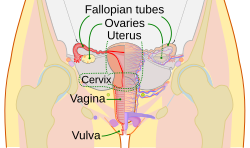
female reproductive system

The female reproductive system (or female genital system) contains two main parts: the uterus, which hosts the developing fetus, produces vaginal and uterine secretions, and passes the anatomically male person's sperm through to the fallopian tubes; and the ovaries, which produce the anatomically female person's egg cells. 


ovary
- these two ovoid ovaries produces eggs and female sex hormones such as oestrogen and progesterone. the female sex hormones are responsible for the development and maintenance of the secondary sexual characteristics in females.
- when the eggs become mature, they are released from ovaries.


Oviduct
- each ovary releases mature eggs into an oviduct or fallopian tube.
-each oviduct is a narrow muscular tube leading from the ovary to the uterus. it had=s a funnel-like opening lying close to the ovary, making it easier for the egg to enter the oviduct.
the egg is usually fertilised in the oviduct.


uterus
-the womb or uterus (plural : uteri) is where the foetus or unborn baby develops during pregnancy.
- the uterus is shaped like an upside-down pear. it has elastic muscular walls. the smooth muscle tissue in the walls of the uterus contract to push the foetus out during birth.
- the soft, smooth inner lining of the uterus is called the uterine lining or endometrium. it plays a part in the embryo implantation. every month, the endometrium is broken down and it flows out of the body together with some blood. it is later built up again.


cervix
-the circular ring of muscles at the lower narrow end of the uterus is the cervix. it enlarges to allow passage of the foetus during birth.


vagina
-leading from the cervix to the birth canal or vagina. the opening of the vagina is the vulva.
semen is deposited in the vagina during mating or sexual intercourse. 
Scheme female reproductive system-en.svg

Asexual reproduction

Asexual reproduction is a mode of reproduction by which offspring arise from a single parent, and inherit the genes of that parent only, it is reproduction which does not involve meiosis,ploidy reduction, or fertilization.


asexual cartoons, asexual cartoon, asexual picture, asexual pictures, asexual image, asexual images, asexual illustration, asexual illustrations

Cell Division

Cells in the body are continually dying hence they need to be replaced which therefore explains why reproduction always begins with cell division. 

Unicellular organisms, e.g. bacteria reproduced by binary fission, a form of asexual reproduction. New daughter cells obtained by binary fission have the same characteristics as their parents cells.


In the multicellular organisms, gametes are produced. The fusion of the two different gametes results in a combination of generic material in the offspring. Therefore, new cells formed from sexual reproduction do not have the same characteristics as their parents.
'Nice try! We only need one of you. You can just turn around and be on your way, buddy.' by Forde, Patrick

sexual reproduction

Sexual reproduction is the creation of a new organism by combining the genetic material of two organisms. The two main processes are:meiosis, involving the halving of the number of chromosomes; and fertilization, involving the fusion of two gametes and the restoration of the original number of chromosomes.


sexual reproduction cartoons, sexual reproduction cartoon, sexual reproduction picture, sexual reproduction pictures, sexual reproduction image, sexual reproduction images, sexual reproduction illustration, sexual reproduction illustrations

Reproduction

Reproduction is required for the production of new individuals (off spring) for the continuity of species.
if organisms do not reproduce, they will become endangered or extinct.
reproduction can be classified as asexual or sexual reproduction.
Asexual reproduction results in the production of genetically identical offspring from one parent, without the fusion of gametes.
Sexual reproduction involves the fusion of two gametes to form a zygote, resulting in the production of genetically dissimilar offspring.
Asexual reproduction is beneficial in a stable environment, or if organism is living in suitable habitat, it also requires less energy and time as it does not require the formation of gametes and bringing them together for fertilization.
Sexual reproduction is useful in a changing environment, where variations might produce survivors under different conditions (nature selects "fittest"). It also requires more energy and time as it requires the formation of gametes and bring them together for fertilization.