Sexually transmitted diseases are diseases that are transmitted from one person to another through sexual intercourse.
Common sexually transmitted diseases include gonorrhoea, syphilis and AIDS.
Sexually transmitted diseases are dangerous because some of them do not always show signs and symptoms until they are too late for treatment.
If left undetected, sexually transmitted diseases may cause serious health problems or even death.
Sunday, 31 July 2011

Assisted Reproduction
Assisted reproduction is used when people have difficulty producing babies. There are two commonly-used methods to help such people to achieve a baby:

In-vitro Fertilisation | Artificial Insemination |
· Eggs taken from woman’s body are placed in a glass dish. · Eggs are fertilised with sperms from the husband. · Fertilised eggs are then divided to form embryos. · One embryo is then placed in the uterus of the woman. · The embryo grows into a baby and is born naturally. | · Sperms from the man are placed in the uterus of the womanusing a syringe. · Sperms move up the uterus and one of them will fertilize the egg in the usual way. |
Fertilization
It is the fusion of the nuclei in a sperm and ann egg to form a fetus.
During this process, the chromosomes in the sperm and the egg fuse together to form a full set of 23 pairs of chromosomes.
Millions of sperm released from the penis are deposited in the vagina.
 The sperms swim from the vagina up the uterus and into the fallopian tubes, many sperms actually die before they reach the tubes.
If a sperm meets an egg in a fallopian tube, fertilization takes place, only one sperm will fertilize the egg.
The fertilized egg begins to divide to form a small ball of cells.
The small ball of cells, now called the embryo, moves down the fallopian tube and enters the uterus.
The embryo secretes a hormone which prevents the corpus luteum from breaking down until a structure called the placenta is formed. the corpus luteum continues to secrete progesterone and oestogen until the placenta is able to take over the production of progesterone and oestogen.
The embryo embeds itself in the uterine lining and develops.
In the event that fertilization does not take place, the egg will break down.
Eventually, LH production is inhibited by high concentration of progesterone in the blood.
The drop in LH level in the blood causes the corpus luteum to break down too.
When the corpus luteum breaks down, progesterone is not secreted.
Without progesterone, the thickened uterine lining cannot be maintained, so it breaks down.
The lining flows from the uterus together with some blood through the vagina, this marks the beginning of the previous menstruation.
FSH is again produced by the pituitary gland and the whole cycle is repeated.
During this process, the chromosomes in the sperm and the egg fuse together to form a full set of 23 pairs of chromosomes.
Millions of sperm released from the penis are deposited in the vagina.
If a sperm meets an egg in a fallopian tube, fertilization takes place, only one sperm will fertilize the egg.
The fertilized egg begins to divide to form a small ball of cells.
The small ball of cells, now called the embryo, moves down the fallopian tube and enters the uterus.
The embryo secretes a hormone which prevents the corpus luteum from breaking down until a structure called the placenta is formed. the corpus luteum continues to secrete progesterone and oestogen until the placenta is able to take over the production of progesterone and oestogen.
The embryo embeds itself in the uterine lining and develops.
In the event that fertilization does not take place, the egg will break down.
Eventually, LH production is inhibited by high concentration of progesterone in the blood.
The drop in LH level in the blood causes the corpus luteum to break down too.
When the corpus luteum breaks down, progesterone is not secreted.
Without progesterone, the thickened uterine lining cannot be maintained, so it breaks down.
The lining flows from the uterus together with some blood through the vagina, this marks the beginning of the previous menstruation.
FSH is again produced by the pituitary gland and the whole cycle is repeated.
The Menstrual Cycle
At birth, a girl has thousands of unripe eggs in the ovaries. At puberty, the eggs ripen at different times, and are released from each of the two ovaries in turn.
Ovulation takes place about once every 28 days.
After ovulation, uterus lining becomes thicker and well-supplied with blood vessels to prepare for development of fetus.
If the egg is fertilised by a sperm, the fertilised egg grows in the uterus. The ovaries then stop releasing more eggs until the baby is born.
If the egg is not fertilised, the egg dies in the uterus. The egg together with blood and thick uterus lining is then discharged through the vagina as menstrual flow.
A regular menstrual cycle lasts 28 days.
In a cycle, ovulation usually occurs about 14 days before the next menstruation.
The fertile period is the 11th - 18th days of the menstrual cycle.
Ovulation takes place about once every 28 days.
After ovulation, uterus lining becomes thicker and well-supplied with blood vessels to prepare for development of fetus.
If the egg is fertilised by a sperm, the fertilised egg grows in the uterus. The ovaries then stop releasing more eggs until the baby is born.
If the egg is not fertilised, the egg dies in the uterus. The egg together with blood and thick uterus lining is then discharged through the vagina as menstrual flow.
A regular menstrual cycle lasts 28 days.
 |
| The Menstrual Cycle |
The fertile period is the 11th - 18th days of the menstrual cycle.
 |
| The Menstrual Cycle |
Wednesday, 20 July 2011
female reproductive system
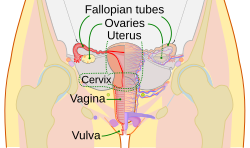
The female reproductive system (or female genital system) contains two main parts: the uterus, which hosts the developing fetus, produces vaginal and uterine secretions, and passes the anatomically male person's sperm through to the fallopian tubes; and the ovaries, which produce the anatomically female person's egg cells.
ovary
- these two ovoid ovaries produces eggs and female sex hormones such as oestrogen and progesterone. the female sex hormones are responsible for the development and maintenance of the secondary sexual characteristics in females.
- when the eggs become mature, they are released from ovaries.
Oviduct
- each ovary releases mature eggs into an oviduct or fallopian tube.
-each oviduct is a narrow muscular tube leading from the ovary to the uterus. it had=s a funnel-like opening lying close to the ovary, making it easier for the egg to enter the oviduct.
the egg is usually fertilised in the oviduct.
uterus
-the womb or uterus (plural : uteri) is where the foetus or unborn baby develops during pregnancy.
- the uterus is shaped like an upside-down pear. it has elastic muscular walls. the smooth muscle tissue in the walls of the uterus contract to push the foetus out during birth.
- the soft, smooth inner lining of the uterus is called the uterine lining or endometrium. it plays a part in the embryo implantation. every month, the endometrium is broken down and it flows out of the body together with some blood. it is later built up again.
cervix
-the circular ring of muscles at the lower narrow end of the uterus is the cervix. it enlarges to allow passage of the foetus during birth.
vagina
-leading from the cervix to the birth canal or vagina. the opening of the vagina is the vulva.
semen is deposited in the vagina during mating or sexual intercourse.
ovary
- these two ovoid ovaries produces eggs and female sex hormones such as oestrogen and progesterone. the female sex hormones are responsible for the development and maintenance of the secondary sexual characteristics in females.
- when the eggs become mature, they are released from ovaries.
Oviduct
- each ovary releases mature eggs into an oviduct or fallopian tube.
-each oviduct is a narrow muscular tube leading from the ovary to the uterus. it had=s a funnel-like opening lying close to the ovary, making it easier for the egg to enter the oviduct.
the egg is usually fertilised in the oviduct.
uterus
-the womb or uterus (plural : uteri) is where the foetus or unborn baby develops during pregnancy.
- the uterus is shaped like an upside-down pear. it has elastic muscular walls. the smooth muscle tissue in the walls of the uterus contract to push the foetus out during birth.
- the soft, smooth inner lining of the uterus is called the uterine lining or endometrium. it plays a part in the embryo implantation. every month, the endometrium is broken down and it flows out of the body together with some blood. it is later built up again.
cervix
-the circular ring of muscles at the lower narrow end of the uterus is the cervix. it enlarges to allow passage of the foetus during birth.
vagina
-leading from the cervix to the birth canal or vagina. the opening of the vagina is the vulva.
semen is deposited in the vagina during mating or sexual intercourse.
Asexual reproduction
Asexual reproduction is a mode of reproduction by which offspring arise from a single parent, and inherit the genes of that parent only, it is reproduction which does not involve meiosis,ploidy reduction, or fertilization.


Cell Division
Cells in the body are continually dying hence they need to be replaced which therefore explains why reproduction always begins with cell division.

Unicellular organisms, e.g. bacteria reproduced by binary fission, a form of asexual reproduction. New daughter cells obtained by binary fission have the same characteristics as their parents cells.
In the multicellular organisms, gametes are produced. The fusion of the two different gametes results in a combination of generic material in the offspring. Therefore, new cells formed from sexual reproduction do not have the same characteristics as their parents.

Unicellular organisms, e.g. bacteria reproduced by binary fission, a form of asexual reproduction. New daughter cells obtained by binary fission have the same characteristics as their parents cells.
In the multicellular organisms, gametes are produced. The fusion of the two different gametes results in a combination of generic material in the offspring. Therefore, new cells formed from sexual reproduction do not have the same characteristics as their parents.
sexual reproduction
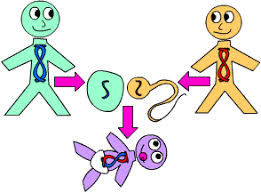
Sexual reproduction is the creation of a new organism by combining the genetic material of two organisms. The two main processes are:meiosis, involving the halving of the number of chromosomes; and fertilization, involving the fusion of two gametes and the restoration of the original number of chromosomes.


Reproduction
Reproduction is required for the production of new individuals (off spring) for the continuity of species.
if organisms do not reproduce, they will become endangered or extinct.
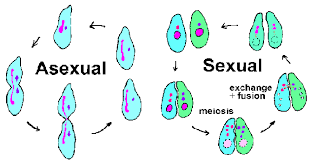
reproduction can be classified as asexual or sexual reproduction.
Asexual reproduction results in the production of genetically identical offspring from one parent, without the fusion of gametes.
Sexual reproduction involves the fusion of two gametes to form a zygote, resulting in the production of genetically dissimilar offspring.
Asexual reproduction is beneficial in a stable environment, or if organism is living in suitable habitat, it also requires less energy and time as it does not require the formation of gametes and bringing them together for fertilization.
Sexual reproduction is useful in a changing environment, where variations might produce survivors under different conditions (nature selects "fittest"). It also requires more energy and time as it requires the formation of gametes and bring them together for fertilization.
Subscribe to:
Posts (Atom)